Showing posts with label penguin pool. Show all posts

Friday

7 steps to opening your pool for the summer


Take The Cover Off
The very first thing you need to do is remove the cover from your pool. If you have a safety cover, you will need an installation rod and hex key to remove the springs from the anchors and screw them down flush to the concrete.
If you have a standard tarp cover with water bags, just remove the water bags and empty them to store for the winter.
Make sure you drain the water off the cover and remove any large debris before taking off the cover. It will make your job a lot easier and it will prevent that stuff from getting into your pool water.
Next, take the cover from one end of the pool and continually fold in half until it’s easy to remove the cover from the pool.
Remove The Winter Plugs
Walk around your pool and find all the return lines. Remove the winter plugs from the return lines and step jets.
Remove the ice compensator from the skimmer buckets. Depending on how you closed it, there should be a plastic bottle, sponge, or “gizmo” in your skimmer that prevents the ice from cracking it. Replace the baskets.
At this time, make sure your pool is filled mid-way up the skimmer opening before starting your filter system.
Get Your Filter System Ready
Before you start your filter system, make sure all of the drain plugs are properly installed. Your filter system should have one main drain plug and your pump may have two.
Replace the pressure gauge on your filter as well as any other parts that belong.
Check the o-ring on your pump lid to make sure it’s in good condition. Bend it between your fingers to check for cracks. If everything looks ok, just apply a Teflon-based o-ring lubricant before screwing the pump lid back on.
Once everything is in place, start your filter system.
Note: Your pump may have to be primed if no water is coming through. Turn off the pump and remove the lid. Fill the pump housing with water. You can use a hose or a giant bucket of pool water to do this. Replace the lid and your pump should prime itself.
Test and Shock
Once your pool is up and running, take a water sample to your nearest pool dealer to get a professional water analysis done. Make sure you pH and alkalinity are properly balanced.
At this point, it’s a good idea to add the proper sanitizer to your water (i.e. chorine). Also, shocking your pool right away is a good idea too.
Cleaning Up
Make sure you clean your winter cover before storing it away for the season. Check your local pool supply dealer for winter cover cleaner.
Also, vacuum your pool using a manual vacuum at first to get all the heavy debris out (if there is any). After that, you can continue to use your automatic pool cleaner.
Opening up your pool is easy and takes no time at all. Ask a friend or neighbor to help and drink plenty of water, or beverage of choice, while working in the heat.
Happy Swimming!

Wednesday

How to make your swimming pool more energy efficient


Why should I build or upgrade to an energy efficient pool?


Reduce Costs

You’ll save money. Energy-efficient pool appliances always pay for themselves in reduced electric bills, and then continue to save money for years to come. By choosing pool equipment such a variable speed pump or pool cover, and by establishing good habits like lowering the pool heater when not in use and proper preventative maintenance, costs to a pool owner can be greatly decreased.

Cuts down on energy waste and saves water

Almost all of a pool’s heat loss—about 95 percent—occurs at the surface, mostly through evaporation to the air and radiation to the sky. By using a pool cover to prevent heat and water loss, the amount of chemical water treatment will also be reduced. A multispeed or energy efficient pool pump can also significantly reduce the power consumption of a swimming pool by over 65%.

Tax incentives and rebates

Did you know that some states offer tax incentives and rebates for homeowners that purchase energy efficient pool appliances? Check to see what incentives and rebates are available in your state.

Energy Efficiency – How?

With a combination of pool products and good preventative maintenance habits, you can improve the heating and energy efficiency of your swimming pool. Variable drive pool pumps reduce utility costs.

Pump Efficiency

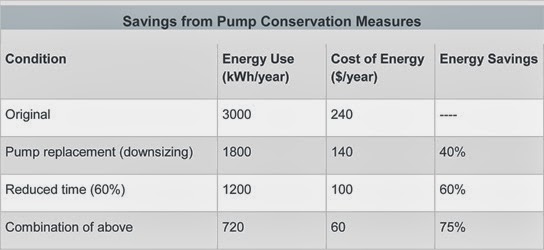
You can save energy and maintain a comfortable swimming pool temperature by using a smaller, higher efficiency pump and by operating it less. On average, an energy efficient pump will use 30-45% less energy than that of a standard pump. The difference over a season can be immense. Pumps now come in two-speed, four-speed, and variable-speed models, so you can turn the speed down for regular daily use saving a lot of energy, and use higher settings for more thorough, less frequent cleanings. New energy-efficient pumps also move the water more efficiently for further savings.
Since pumps circulate the water to keep it clean, the better they work, the less a filter has to work.Visit www.pentairpool.com/pumpcalc to see how much money you could save by switching to an IntelliFlo variable speed pump.
  • Pentair IntelliFlo
    Pentair Water Pool and Spa® was the first to introduce variable speed technology with their IntelliFlo® pumps over 5 years ago. Today, IntelliFlo continues to lead the way, out-selling all other variable speed brands combined. Their ultra-efficient permanent magnet motor design reduces noise and vibration for greater efficiency and longer pump life. 8 programmable speed settings ensure minimum flow requirements are being used for every pool task – filtering, heating, cleaning, spa-jets and more – to optimize performance and minimize energy use. In fact, with IntelliFlo technology, pool owners can save $620 to $1,360 each year compared to other pumps.
  • With the Hayward EcoStar family of pumps, money flows back into your pocket. EcoStar is the industry’s most energy efficient variable speed pump, thanks to a super-efficient permanent magnet, totally enclosed fan cooled (TEFC) motor and industry leading hydraulic design. Tests prove that EcoStar can save you up to 90% on energy costs compared to ordinary single speed pumps. EcoStar matches pump flow to a pool's needs, versus running at full power 100% of the time. It's fully programmable with a self-contained 24-hour clock and up to 8 custom speed and timer functions that allow EcoStar to manage flow throughout the day. Whether used in new construction or aftermarket applications, EcoStar is the perfect choice.

Thursday

A Solution if your cleaner gets stuck on your main drain


Main Drain Clip-On has developed an innovative device that prevents the automatic pool cleaner from getting "stuck" on most main drains used in residential pools. One of the most effective pool tools available, this device is inexpensive and is easy to install without getting into the water.

Visit their online store to order this product.

Wednesday

Your pool dealer offering you that big pump? Might not be such a good idea.

How many times have we pulled up to the drive up window and said supersize my order? I mean, after all, we are Americans and we do believe that bigger is better. Why settle for regular Fries when I can double its size for 10 cents more. Who cares if I get three times more fat and carbs. You don’t have to look any further than the auto industry to see examples of this either. Hummers, Suburban’s, Tahoe, Yukon, all bigger and better right?

Well that is until our values changed and we started caring more about fuel efficiency and saving the planet and how darn cute we look riding down the road in our Audi TT or VW, or Prius. You see we started to pay attention to fuel efficiency and realized that we could get to the same place on time and get there on 50 miles to the gallon. (Best case scenario) Saving us money, fuel and the planet all at the same time.

These same principles hold true with swimming pools and how we tend to think that supersizing our pump and filter system must be better right? Well. . .this isn’t exactly a TRUE statement. Let’s take a look and see what needs to be Supersized, What doesn’t, and Why.

New pool owners tend to think that the bigger pump... the better, the larger the filter, the better… Right? So. . .How can I have a clean pool and not spend $100 per month extra on my utility bill.

It turns out that there are three really important things that we need to think about when talking about what is the best circulation system.
1. Size the Plumbing Correctly to allow for Proper Circulation.

The first is properly sizing the plumbing that we use when our pool is being built. In this case bigger is better. I know I am already contradicting myself, but stay with me here. Staying with my Fast-food analogy, if you are drinking a coke – Which is easier and takes less effort to use? A nice big McDonalds straw or a little brown swizzle stick straw? Carry this over to your pool. . .Which do you think will allow water to flow easier with less restriction? Big Pipe. . .or Little Pipe? So in this case PIPE SIZE = bigger is better 2”, 2 1/2″, 3″ and so on. Bigger Pipe is optimum to allow maximum flow.

2. Pump Size – Not available in “Supersize” option (unless you want to pay beaucoup bucks!!) The second is the big one and still to this day is fought over by those unwilling to see the light… Pump size.

ALERT! In many sales presentations it is pushed on you, the homeowner, that“ the other guy is only putting a ¾ hpr pump but we are a 1 ½ hpr on therefore we are the better deal” Not True! In fact, guy number two may actually be running a less efficient system that will end up sucking money out of your pocket book for years to come.

Do a Little Research First! Nowadays, you need to ask the question: How many gallons per minute do I need? Instead of asking: How much horse power do I need? Did you know that in a lot of cases you can run a smaller pump for 24 hours a day for significantly cheaper than a larger pump for 8 hours a day?

“Wait a minute“,you say, “But I am only running it 8 hours a day…surely it is less money!?” Nope! it’s not, and it won’t keep your pool as clean and could cost you more than double what it should.
There are calculators, charts and guides available from several pump manufacturers that can help with choosing the right size pump and filter for your pool:
Pentair Pool
Jandy
Hayward

All REPUTABLE pool builders and service companies are seeing the wisdom of 2 speed pumps and variable speed pumps. These pumps allow you even more control over efficiency and will return your investment in most case within 4-6 months. Not to mention you can run cool water features with them without the added operational expense.

3. DON’T forget about the Speed Bumps!
And finally, let’s make note of all the other speed bumps that get thrown in the way of your swimming pool water’s flow: Heaters, Salt Systems, Chlorinators, excessive PVC 90′s, 45′s, connectors, elbows etc… Your swimming pool builder should take all of these additional options into consideration when they calculate your hydraulics system....and properly size the pipes, filter, and pump. All systems manufacturers have maximum gpm (gallons per minute) ratings available for each piece.

When all is said and done your swimming pool should run efficiently and for less money! To find out in more detail about these topics please visit the sites links above. And always, contact any one of us at Penguin Pools! We’re here to help you with any vinyl liner, fiberglass, composite, gunite, concrete swimming pool issues. 612-225-0007

Friday

How NOT to install a fiberglass pool


You know you've had a bad day when a crane is parked ON your garage. Video below is of the actual pool crashing in on the roof. As would be expected in this situation....language alert.....somebody used a couple bad words toward the end of the video. had it been me....I think the verbage would have been even stronger.


A home improvement project went terribly wrong when a crane fell on a home in Shoreview, Minnesota.
Crews were trying to install a pre-fab fiberglass pool in the homeowners backyard when the crane came crashing down onto the house, causing the truck to tip up into the air.No one was hurt.It happened around 2pm Friday.
At last check crews were still trying to get the crane off the house.


More video:


Thursday

Swingaway Hinged Ladders for autocovers


Tired of having your automatic pool cleaner get tangled up on your pool ladder, or having to remove your ladder to close your auto cover?
When an autocovers is installed on a new or existing pool, there is always one problem... the ladder in the deep end is always in the way of the cover closing.
Cover companies came up with an easy solution to this and installed hinges on the ladders. The only draw back to their hinge is it uses a small pin to lock the ladder in place. These are small pins and can very easily get lost and bent. More often than not, it is easier for homeowners to just stop using the ladders.
Our hinges incorporate the locking pin into the hinge itself. The pin is internally mounted which makes it easy to lock and unlock. To unlock the hinge, you simply lift the entire ladder 1 inch. To lock the hinge, you simply let the ladder slide down and lock into place. It couldn't be easier.
These hinges can be used for more than auto covers. If you have an automatic cleaner that is always getting tangled on the ladder, this is the solution for you. No more worrying about your cleaner getting stuck and staying in place for hours. Simply lift the ladder out of the water and let it go.

They also make for easy winterization. To order swing away ladder hinges...call Penguin Pools at 612-225-0007


.

Friday

The difference in covers between a top track, and a recessed


CLICK TO ENLARGE ANY PICTURE
This is a recessed cover above, notice how the cover rides in the same track we install the liner in, on the side of the pool wall and then rolls into a well under the diving board.

This is a top track cover below. Look closely and you will see the track on top of the concrete that the cover slides in. This was an existing
pool that we put a cover on two years after we built it. We had to build a bench above the deck for it roll into, in order
not to tear up the tiles. On a new pool it would be underground like picture 1 or 3.

Another picture of a top track cover, we use these for two basic reasons, the customer saves about $1500 because special coping is not needed atop the pool wall, so it's a cheaper option. If you have a freeform pool like the one below, it has to be top track, because it needs a straight edge to close.